
Every mile, done right.
Five-minute lessons for drivers, dispatchers, dock crews and fleet managers. Inspections, securement, rest, paperwork and the road itself: one real situation per lesson, the exact checks and steps to take, on a phone between loads.
- 105
- lessons
- 21
- tracks
- 10
- areas of trucking work
- 5
- minutes each
Most trucking training happens once, at orientation, and then on the job, differently on every shift.
A new driver rides along with whoever is available, picks up their habits, good and bad, and learns the rest from close calls. The standard lives in a binder in the dispatch office, and the same mistakes come back with every new hire and every new lane.
-
Too long to schedule
A half-day classroom session means taking drivers off the road, so it happens once, at orientation, if at all.
-
Too general to use
Advice to "drive safely" does not tell anyone how to check a fifth wheel by hand or what to do when a load has shifted.
-
Too rare to stick
A habit taught once is a memory, and a faint one. A pre-trip routine needs repeating until it runs without thinking.
One situation, five minutes, the steps to take.
Every lesson takes one real moment on the road, in the yard or at the dispatch desk and shows what good looks like, what usually goes wrong and how to recover. A presenter talks it through; the learner reads, listens and answers.
-
One road, yard or dispatch situation per lesson
A walk-around at dawn, a load that shifted, a customer whose dock is closed. The lesson shows the standard, the common mistake and the recovery, with the exact checks and steps.
-
Plain English, for every crew
Written for teams where English is often a second language. Short sentences, no jargon, and every industry term explained in one line the first time it appears.
-
Checked, not assumed
Each lesson ends with a few questions about what you would actually do, so the habit is tested before the road tests it for real.
Built for the whole operation, not just the driver's seat.
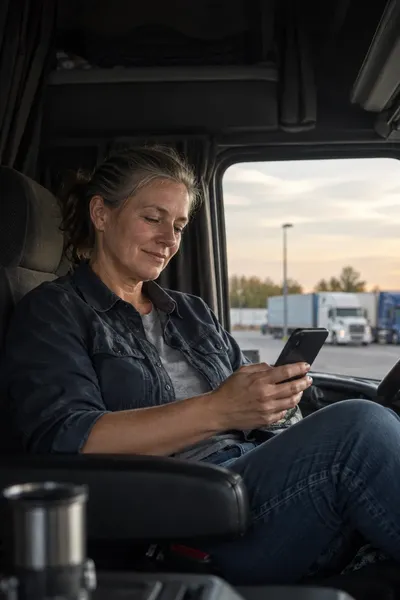
Tracks are organised by role and by situation, so a driver, a dispatcher and a dock supervisor each get the lessons that match their day.
-
Drivers
Pre-trip, securement, driving in weather, hours and rest, the roadside and the customer.
-

Dispatchers
Routing, planning, communication with drivers and customers, and what to do when a run goes wrong.
-

Dock and yard crews
Loading, unloading, yard moves, forklifts, seals, damage and the paperwork that goes with them.
-

Fleet managers
Briefings, coaching, costs, incidents and the habits that keep a fleet safe and profitable.
Ten areas of trucking work, opened track by track.
Every area starts with practical foundations and goes deeper by role. Free tracks let anyone begin; Premium opens the rest for a person or a whole fleet.
-
Vehicle Readiness
3 tracks, 15 lessons- The Walk-Around RoutineFree to start
- Cab and Controls Checks
- Daily Care Habits
-
Behind the Wheel
3 tracks, 15 lessons- Space and Speed
- Adverse Conditions
- Warning Signs and Countermeasures
-
Freight Handling
2 tracks, 10 lessons- Tie-Down FundamentalsFree to start
- Axles and Distribution
-
Paperwork and Customers
2 tracks, 10 lessons- At the Receiver
- Proof of Delivery and Claims
-
Specialized Freight
2 tracks, 10 lessons- Labels, Classes and PapersFree to start
- Reefer Operation
-
Yards, Docks and Warehouses
1 tracks, 5 lessons- Chocks, Locks and Levelers
-
Dispatch and Planning
2 tracks, 10 lessons- Long-Haul RoutingFree to start
- Boards, Briefings and Tracking
-
Economics of the Road
2 tracks, 10 lessons- Driving Technique
- The Price of a Mile
-
Incidents and Roadside Situations
2 tracks, 10 lessons- First Steps on the ShoulderFree to start
- At the Scene
-
Fleet Leadership
2 tracks, 10 lessons- Coaching, Recognition and Retention
- Culture and Coaching
New tracks are added to the library over time. What you see here is what learners can open in the app today.
Start free. Pay for the rest by the month, the year or the seat.
Free tracks cost nothing. Past them there is one flat price for a person and one price per seat for a fleet or a team, in US dollars.
- Free
- Free tracks across several areas: the walk-around routine, tie-down fundamentals, first steps on the shoulder and more.
- $29.99 a year
- Every area and every track, for one person, billed once a year.
- $24.00 per seat, a year
- Per seat for a fleet or a team, with an invite link, a web dashboard and invoices.
Before you ask
How long does a lesson take?
Is it only for people who speak English well?
Does it work on a phone?
Does it teach the rules for my country or state?
Can we give each role only the lessons that apply to them?
How do we know whether people actually did the training?
What does it cost?
Tell us about your operation.
Say roughly how many drivers and staff you have and which roles you want to start with. We answer every message ourselves.
Get in touchStraight to a person, not a sales sequence.